
道場TOP ネタ一覧 shoppq道場
After three months with the DOOGEE V10, I have some thoughts I just have to get off my chest
- ◇評価 0ポイント
- ◇閲覧回数 22回
- ◇登録日
- 2026年9月18日
-
- aline
- 道場主
Lv.23
I’ve always had a hard-to-define curiosity about rugged phones. Watching reviews where people toss them into water or drop them onto concrete from great heights is certainly satisfying. But honestly, when I actually shelled out the money to buy one, a different question was on my mind: can this thing actually function as a normal phone?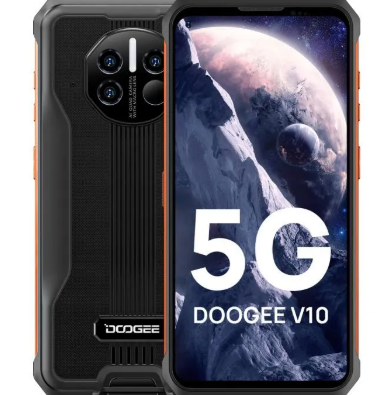
I picked up the DOOGEE V10 three months ago. It wasn't because of the specs—that 720p screen is practically a joke in 2024—but simply because I needed a phone that could survive alongside me in all sorts of harsh environments.
It certainly survived. *I*, on the other hand, was driven nearly mad by it.
Let’s start with the aspect that gave me the most peace of mind.
My previous phone was a flagship model; I’d shattered the screen once, and the replacement cost over a thousand yuan. Ever since then, I’ve been terrified of using a phone without a case.
The first thing you notice when holding the V10 is that it doesn't feel like a phone at all. It’s as thick as a pocket dictionary, encased in chunky rubber with distinct shock-absorbing structures on the corners, giving it a heavy, substantial presence. Weighing in at 340 grams—nearly double the weight of my old phone—it’s so heavy that I have to hold it in place while walking if it’s in my pocket, for fear it might drag my pants down.
Yet, it was precisely this "un-phone-like" design that gave me the confidence to really put it through its paces outdoors.
Once, while washing vegetables at a campsite, the phone slipped into a basin full of water. I froze for a second before fishing it out—the screen was still on, and everything was working perfectly. The official specs claim it can withstand depths of 5 meters for two hours, boasting both IP68 and IP69K ratings. I didn't test it to that extreme, but it took everyday rain, faucet rinses, and even being submerged for a few minutes completely in stride.
On another occasion, while pulling something out of my backpack's side pocket, the phone tumbled straight onto a patch of gravel. When I picked it up, there was just a faint scuff on the frame, but the screen remained completely intact. The official specs claim it can withstand drops onto concrete from a height of 3 meters; it has also passed MIL-STD-810G military-grade testing, covering conditions like humidity, low pressure, and acidic environments. That feeling of "not having to worry if I drop it" is something I’ve never experienced with any other phone.
That infrared thermometer turned out to be more useful than I expected.
Before buying it, I thought it was just a gimmick—after all, how special is measuring body temperature? But in practice, it’s become one of the features I use most often.
It has an accuracy of around 0.2°C and is handy for all sorts of things: checking if the radiator is warm before heading out in the morning, testing water temperature when making formula for my child, or spotting abnormal heat in the engine bay while working on the car. It isn't a medical device—the manufacturer explicitly states it’s for reference only—but in daily life, it really solves those "I just want to know" moments.
They weren't kidding about the battery life.
An 8,500mAh battery—that number sounds almost like a joke. My previous phone had a 4,500mAh battery, and charging it twice a day was the norm.
I’ve been using the V10 for three months now. With my daily commute—watching videos, browsing the web, and replying to messages—I only need to charge it every two to three days. And that’s not by rationing usage to stretch it out; I use it exactly how I want to. The official claim is 500 hours of standby time (over 20 days), and I believe it. I once forgot my charger on a business trip and managed to make it last four days; when I got home, I still had 15% battery left.
The 33W fast charging gets it to about 45% in half an hour, with a full charge taking roughly an hour and a half. It also supports 10W wireless charging and OTG reverse charging—I’ve used it to charge my earbuds; the speed isn't blazing, but it’s enough for an emergency boost.
Now, I’m going to be completely honest.
The screen is its biggest weak point.
It’s a 6.39-inch IPS display with a resolution of only 720×1560 and a pixel density of 269 ppi. What does that actually mean? Even budget phones in the sub-1,000 yuan range now feature 1080p displays; once you’re accustomed to a sharp, high-resolution screen, the jagged edges on this display are immediately noticeable when reading text. Image details look muddy when scrolling through Weibo, and video clarity clearly falls short of expectations.
TechRadar’s review explicitly lists "low screen resolution" as a downside. I can’t fault them for that—after all, this is a rugged phone, not a flagship device designed for media consumption. However, if you spend most of your time watching shows or videos on your phone, this screen will likely frustrate you.
Another issue that bothers me: it lacks a microSD card slot.
With 128GB of internal storage—and the system taking up a chunk of that—you’re left with just over 100GB of usable space. I take a lot of photos and videos, so my storage fills up quickly. Both the official website and GSMArena confirm that the V10 doesn't support expandable storage. TechRadar also lists this as a drawback. For a heavy user like me, this means I have to regularly transfer data to my computer; otherwise, I’m constantly forced to delete files to make room.
As for performance—it’s adequate, but don’t expect miracles.
It runs on the Dimensity 700 processor, scoring around 360,000 on AnTuTu. It handles daily tasks like browsing apps and watching videos without issue, but it clearly struggles with demanding games. For a title like *Genshin Impact*, it can barely manage medium-to-low settings, and frame rates fluctuate noticeably. It was never intended to be a gaming phone—that was clear from the start.
One more small detail: the speaker.
It’s not bad, but the placement is a bit odd. When watching videos in landscape mode, it’s easy to accidentally block the speaker with your hand. The volume is quite loud, but the sound quality is nothing special—don't set your expectations too high.
So, who is this phone actually for?
After using it for three months, my conclusion is clear.
The V10 isn't an "everyday phone"; it’s a phone designed for specific scenarios.
If you work on construction sites, spend a lot of time outdoors, perform field operations, or are simply a "phone killer"—the type of person who shatters three screens a year—then the V10 has virtually no competition at this price point. Its ruggedness is the real deal, its battery life is solid, and the infrared thermometer is genuinely functional.
However, if you prioritize comfort in daily use—seeking a stunning display, a smooth gaming experience, or a slim, lightweight body—then this isn't the phone for you. With a weight of 340g and a thickness of 16.1mm, this is a device designed to offer peace of mind rather than sheer comfort.
TechRadar described it as having a "competitive price," with battery life and fast charging as standout features. I agree. But I would add this: be clear about what you want before buying it. If you need a tool that can handle rugged environments—from mountains to the sea—it’s worth it. If you want a phone for elegantly binge-watching shows in a café, you might find yourself missing your previous device.
I still haven't replaced it. Every time I fish it out of the water or pick it up off the ground, that reassuring feeling of "it’s still going strong" is something other phones simply can't provide.
DOOGEE 8500mAh/32.73WH 3.85V BAT21M188500 Battery
|
|
【キーワード】
登録されていません
|

|
  |
ブログ? そんなの必要ありません! 今日から、いきなりアフィリエイトスタート!
【まにあ道アフィリエイト】まにあ道ならAmazonアソシエイトIDを利用してネタを書くだけで、お気軽に始めていただけます。


-

-
 After three months with the DOOGEE V10, I have some thoughts I just have to get off my chest(0)
aline
(道場主)
After three months with the DOOGEE V10, I have some thoughts I just have to get off my chest(0)
aline
(道場主)





 シュリのおすすめネタ
 この道場の人気ネタ
-
New Battery Laptop Batteries ASUS 11.5... -
MateBook D 14: A laptop where you need... -
New Battery Tablet PC Batteries ASUS 7... -
New Battery Laptop Batteries HONOR 15... -
High-compatibility battery CORE-M4 for...
このネタをソーシャルブックマークに登録する
 まにあ道の人気ネタ
-
拋棄式電子煙能否從外觀分辨真假? -
「ワンピースレストラン バラティエ」のメニューをルフィ&ウソップ&サンジの声... -
【亀の病気】目が開かない・白く腫れる「ハーダー氏腺炎」 薬と治療 まとめ -
【イベントレポ】格闘技大会「公武堂ファイト」に まにあ道が乱入! -
互換用バッテリー Vivo iQoo Z9,iQoo Z9 Turbo 60...
コメントはまだありません。